Antler Research Report

Bottlenecks & Switching Traps

The visa routes preventing international founders from building in the UK

Author

Adam French, Partner, Antler

Introduction

Every year, Antler receives around 10,000 applications from aspiring founders looking to build tech startups in the UK. Around a fifth of these founders are based outside the country and want to move here to build their tech companies.

These international founders include some of the best founders we meet. They are alumni of the likes of Google, Amazon, and Goldman Sachs, among many others. They are exactly the kind of founder profile that the world's third largest tech ecosystem should attract.

And yet, time and time again, we can't invest in them because they can't get a visa.

These are the two most common scenarios we face:

  1. A brilliant engineer at Google wants to leave to build their own startup. But their Skilled Worker visa has been sponsored by Google and they can't switch to a different visa. They have to leave the country to start their business
  2. A young, ambitious founder wants to come to the UK but they can't get an Innovator Founder visa (the only route open to founders without an established track record) because of the cost and the bureaucracy

Living with this frustration day in, day out for years led us to take a deeper look at the visa routes actually open to founders, and the Home Office data relating to applications and grants.

We first submitted FOI requests to the Home Office in March 2026. Seven months later they have shared some public databases, but refused to answer all of our questions. An Internal Review has taken more than 40 days so we have referred the case to the ICO.

So we have analysed the data the Home Office makes public, and our own database of founders.

What we have found is a system with structural bottlenecks and traps that make it too time consuming and too expensive for founders to realistically consider coming to the UK.

The visa routes that matter:

There are now three realistic visa routes for potential founders. Innovator Founder, Global Talent and High Potential Individual.

Global Talent and High Potential Individual both require proof of an individual's academic or professional success. If you have a long career behind you in tech, these are great.

If you are an aspiring founder with a great business idea but no real track record of success, the only route is the Innovator Founder visa. And that's where the problems start.

The challenges:

1. The endorsement body bottleneck for Innovator Founder

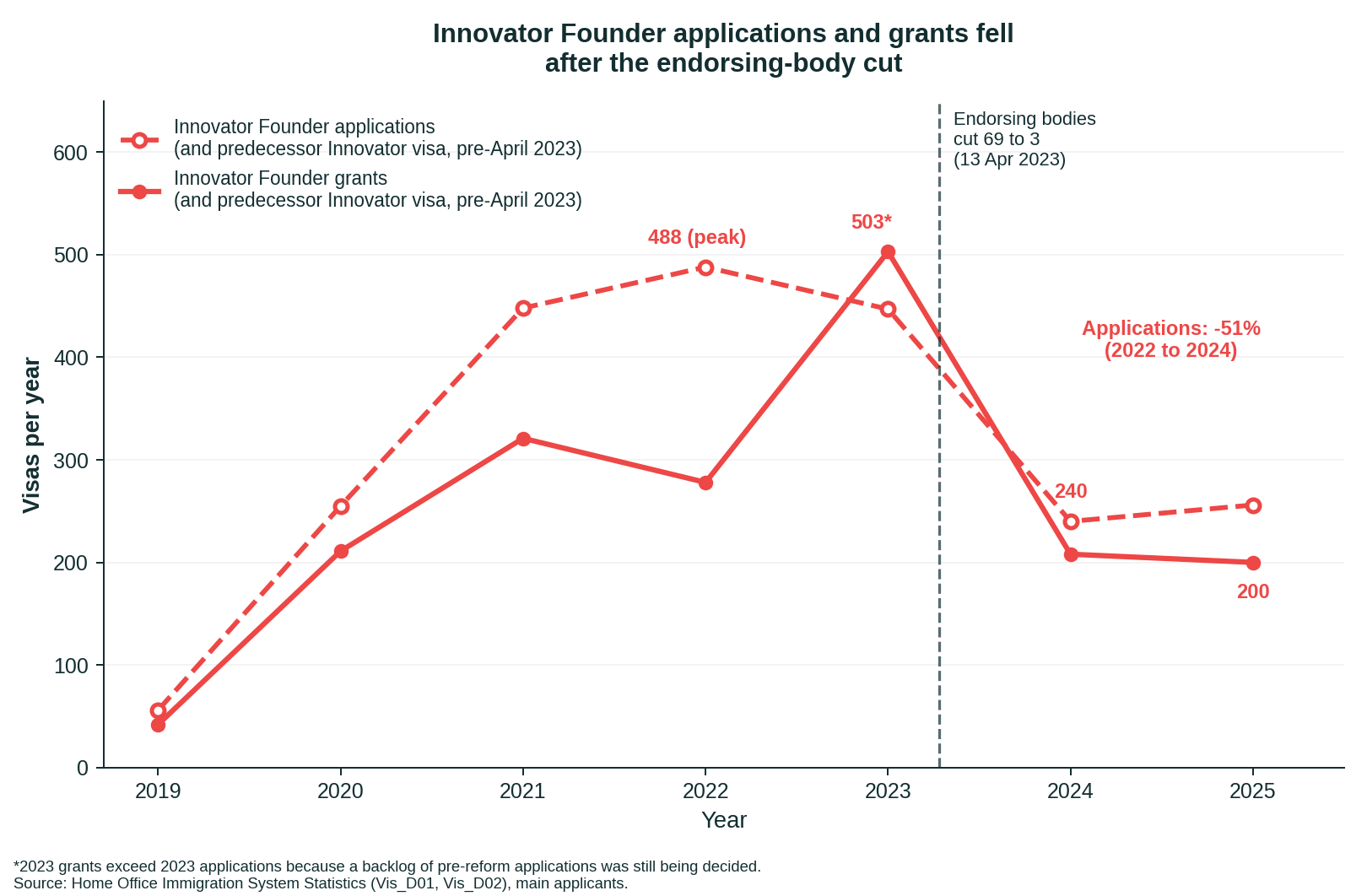
The number of endorsement bodies for the Innovator Founder visa contracted from 69 to 3 in April 2023. Since then, applications for the Innovator Founder visa have fallen by 48%, while the Home Office's approval rate has held at around 84%.

By comparison, Global Talent visas have increased by 446% since 2020.

At a conservative estimate, these 3 endorsing bodies have made up to £950k since 2024 from Innovator Founder fees.

2. The switching trap

For years, around 400 people a year successfully switched from a Skilled Worker or Student visa onto a founder visa route.

Since 2021, successful transitions from a Skilled Worker or Student visa onto a founder-operator route collapsed 92% - from 425 in 2021 to 35 in 2025.

By contrast, Global Talent hasn't seen an equivalent collapse. Switching rates are 90x higher than for Innovator Founders.

3. The hidden costs

The Home Office says an Innovator Founder visa costs £1,357.

When you add in the cost of endorsement (£1,000), the cost of two mandatory contact meetings (£1,000), an Immigration Health Surcharge (£3,105 across three years) it is actually £6,462. That excludes any legal or advisory fees.

You also have to pay fees for any dependents. On average, Innovator Founder applicants have 1.35 dependents, bringing the total family cost to £11,400–£12,500 - 8.4–9.2x the headline fee.

In France, the equivalent route costs €449. In Germany it's €75-€100.

Since 2019, the UK has charged international founders more than £15M for the right to build a startup in the UK.

Why does this matter?

We are living through a period of unprecedented growth and competition in the global tech ecosystem. Record numbers of startups are being created, and Europe is building rocketship unicorns faster than ever.

Never before has it been more important to bring the best founders to the UK, and to allow them to build potentially era-defining companies at speed.

Methodology

This research is built on an analysis of over 32,000 individual visa applications and nearly 2 million UK immigration extension records spanning a decade, cross-referenced against Antler's own founder pipeline and a six-country international cost comparison.
THE DATA

Contents

Chapter One

The Collapse of the Innovator Founder Visa

66 of 69 endorsing bodies shut out overnight - and applications have fallen 48% since.

Key data points

69 → 3The number of organisations authorised to endorse new applicants
−51%Innovator Founder applications from their 2022 peak to 2024
+446%Growth in Global Talent visas since 2020

Innovator Founder launched on 13 April 2023, replacing two predecessor routes - Innovator (launched 2019) and Start-up. Where this report tracks the route back to 2019, it refers to this continuous lineage; the £1,000 endorsement fee and £500 contact-point-meeting fees have applied without change across the transition, confirmed directly against gov.uk's own fee-change notices.

Innovator Founder applications and grants fell after the endorsing-body cut

Innovator Founder applications and grants fell after the endorsing-body cut. Dashed red line: applications; solid red line: grants, including the predecessor Innovator visa before April 2023. Endorsing bodies cut from 69 to 3 on 13 April 2023. Applications fell 51%, from 488 in 2022 to 240 in 2024. Grants reached 503 in 2023 and 200 in 2025. The 2023 grants exceeded applications as a backlog of pre-reform applications was still being decided. Source: Home Office Immigration System Statistics (Vis_D01, Vis_D02), main applicants.

On 13 April 2023, the UK government cut the number of organisations authorised to endorse new Innovator Founder applicants from 69 to just 3 - a 95.7% contraction, overnight. Because an endorsement letter is required before anyone can apply, applications are a close proxy for endorsements issued. They have fallen 51%, from a peak of 488 in 2022 to 240 in 2024, and grants have fallen 32%, from an average of 300 a year in 2021-22 to 204 a year in 2024-25. The Home Office is not refusing more people: it approved around 84% of decisions both before and after the reform. The squeeze happens before an application is made, at endorsement. (2023 is left out of these comparisons because grants that year exceeded applications, as a backlog of pre-reform applications cleared.)

Applications have recovered slightly from their 2024 low of 240, but at 147 in the first half of 2026 they remain around 40% below the 2022 peak on an annualised basis.

Grants have fallen 28% over the same period, from 278 in 2022 to 200 in 2025. The Home Office approved around 84% of decisions both before and after the cut, so the squeeze is happening at endorsement, before an application is made.

Over the same period, Global Talent - a route without the same bottleneck - saw grants rise 446% since 2020, with applications holding at around 4,000 a year. This is consistent with one specific route being squeezed at the endorsement stage, while a comparable route without that bottleneck thrived.

Chapter Two

The Switching Trap

The number of people successfully switching from a Skilled Worker or Student visa onto a founder visa route is down 92% in four years - in two distinct stages, with two distinct causes.

Key data points

425Successful switches in 2021
35Successful switches in 2025
−92%Collapse since 2021

Successful switches from a Skilled Worker or Student visa into a founder route: 92% collapse since 2021

The collapse happened in two stages: legacy routes first, Innovator Founder second

This collapse happened in two distinct stages, not one. Switches into Start-up and the legacy Tier 1 - Entrepreneur route fell first - down 76% between 2021 and 2023 (382 to 93) - as Start-up closed to new applicants and Tier 1 - Entrepreneur was phased out. This had nothing to do with the endorsing-body reform. Innovator Founder itself was, at this point, still growing: switches into it rose every year from 2019 to 2023 (1, 9, 43, 47, 55).

Only after the legacy routes had fully closed did Innovator Founder's own numbers turn down - from a peak of 55 in 2023 to 35 by 2025, a 36% fall, tracking the endorsing-body cut precisely. The route people used to switch closed first. Only then did the route built to replace it become the bottleneck.

This problem is likely to get worse before it gets better. The government has proposed extending the standard qualifying period for settled status from 5 years to a 10-year baseline (up to 15 years for some roles), under a reform called "earned settlement." It hasn't been finalised - a decision is expected later this year - but it's proposed to apply to people already partway through a visa today, not just future arrivals. If it goes ahead, it roughly doubles the number of years a sponsored employee is exposed to exactly the bottleneck described above, before reaching the unconditional freedom that comes with settlement.

Chapter Three

The Hidden Costs

The government says an Innovator Founder visa costs £1,357. The real cost is £6,462 - and up to £12,500 with a family.

Key data points

£1,357Government headline fee
£6,462Real solo cost
£11,400–£12,500Real cost with family
€75–100Equivalent route in Germany

The real cost of an Innovator Founder visa is 4.8–9.2x the government's headline figure — and far above European peers

The government's own headline figure for an Innovator Founder visa is £1,357. Once you add the mandatory endorsement fee (£1,000), two mandatory contact-point meetings (£1,000), and the Immigration Health Surcharge (£3,105 across three years), the real cost to a solo founder is £6,462 - 4.8 times the headline figure, and that excludes any legal or advisory fees. Founders with families pay more still: with an average of 1.35 dependants, the typical total cost rises to £11,400–£12,500, up to 9.2 times the headline fee. By comparison, the equivalent route costs roughly €449 in France and as little as €75–100 in Germany.

Since 2019, the UK has charged international founders more than £15 million for the right to build a startup here. This figure applies the Home Office's own historical fee and Immigration Health Surcharge rates for each year - not today's rates applied retroactively - and covers the full Innovator / Innovator Founder lineage from 2019 to 2025."

Chapter Four

Conclusion: Policy Recommendations

1) Broaden the endorsing-body pool by allowing British Business Bank-backed VC firms to endorse founders directly - a "Venture-Backed Founder Visa."

This would replicate what already works elsewhere: France runs a structurally similar endorsement model with ~80 recognised bodies, at roughly a ninth of the UK's cost, and its founder-visa volumes haven't collapsed the way the UK's have.

British Business Bank-backed funds could plausibly bring the UK's endorser pool to a similar order of magnitude.

2) Reduce the cost and gatekeeping of the Innovator Founder visa specifically, to bring it in line with comparable European routes.

At £6,462 for a solo applicant (£11,400–12,500 once a typical family is included), Innovator Founder costs roughly 9x France's equivalent route and is gatekept by just three organisations, against France's ~80.

Global Talent - a comparably-priced route without a gatekeeper bottleneck - grew 446% over the same period Innovator Founder collapsed, showing this isn't a British-tech-appetite problem; it's a design problem specific to this one route.

3) Give sponsored employees who want to found a company the same freedom already granted to other visa categories, such as spousal visas.

Successful transitions from a Skilled Worker or Student visa onto a founder-operator route collapsed 92% - from 425 in 2021 to 35 in 2025 - reversing a stable six-year pattern. Within that, the Innovator Founder-specific route alone fell 36% from its 2023 peak (55) to 35 in 2025, after its predecessor route (Start-up) had already closed to new applicants.

CASE STUDIES

Case Study 01

12 years in the UK, and no right to build.

One founder we backed had lived and worked in the UK for 12 years, and went to secondary school here. We assumed he had the right to work. Only after our investment committee had approved the deal did it emerge that he was on a student visa. That meant he could not be a director of his own company, or own more than 10% of it while working for it. To stay with the business, he had to switch to the Innovator Founder visa, and had to borrow money to cover the cost. The company could not formally join our portfolio until it was resolved.

Case Study 02

Refused by Global Talent, saved by Innovator Founder.

One founder arrived in the UK on a visitor permit as her European visa was running out. She had to leave the country before her own company's investment committee. She applied for a Global Talent visa, and was refused on every criterion. Because the online portal had not updated, she only found out two weeks later, leaving 12 days to appeal. While her status was unresolved, we could not progress the investment documents. She eventually secured an Innovator Founder visa - the only route open to a founder without an established track record.

Case Study 03

A company held up by one visa.

Our investment committee approved one company with three co-founders. Two signed the investment documents straight away. The third could not, because he was still waiting for permission to work. The company could not formally join our portfolio, and the deal had to be restructured while he waited. At one point the team considered setting up a new company without him, then hiring him as CTO so the business could sponsor his visa - rebuilding the company around the visa system rather than the product.